Skip to content
The Learning Agency
  • Home
  • About
    • About Us
    • Our Team
    • Our Openings
  • Our Work
    • Our Programs
    • Case Studies
    • Guides & Reports
    • Newsroom
  • The Cutting Ed
  • Home
  • About
    • About Us
    • Our Team
    • Our Openings
  • Our Work
    • Our Programs
    • Case Studies
    • Guides & Reports
    • Newsroom
  • The Cutting Ed
The Learning Agency
  • Home
  • About
    • About Us
    • Our Team
    • Our Openings
  • Our Work
    • Our Programs
    • Case Studies
    • Guides & Reports
    • Newsroom
  • The Cutting Ed
  • Home
  • About
    • About Us
    • Our Team
    • Our Openings
  • Our Work
    • Our Programs
    • Case Studies
    • Guides & Reports
    • Newsroom
  • The Cutting Ed

5 Questions With Medha Tare, Ph.D.

The Cutting Ed
  • September 2, 2026
Tasha Hensley

Harnessing technology’s potential in education requires designing with a clear understanding of how kids learn and what they need to thrive. In this 5 Questions interview, Medha Tare, Ph.D., senior director of research at the Joan Ganz Cooney Center at Sesame Workshop, discusses the center’s work bridging learning science and product design. She also highlights the importance of co-designing with students and how the field can create more meaningful digital experiences for learners.

What do you do?

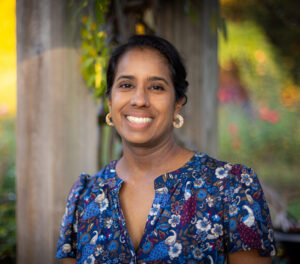
Medha Tare, Ph.D.

I am the head of research at the Joan Ganz Cooney Center, which is a research and innovation lab within Sesame Workshop, the nonprofit that produces Sesame Street. Our projects focus on how emerging technologies for kids can be designed to support learning, development, and well-being.

I lead our Cooney Center Sandbox initiative, where we work directly with early-stage product partners to translate research from the learning sciences (e.g., the science of reading) into product design and center children’s voices through co-design. This work involves our interdisciplinary team of learning scientists, human-computer interaction experts, educators, and designers, who closely examine a product’s underlying pedagogy and design to make concrete, actionable recommendations for improvement and alignment with research.

The Cooney Center also publishes reports and resources for the field, such as our new Co-design with Kids Toolkit, which features techniques, videos, and case studies showing how to bring kids authentically into the design process. We also recently published Translating Literacy Research to Edtech, which highlights misconceptions about the science of reading and shares examples of how our experts have advised various product partners on putting research into practice.
Why is this work important?

Children and families face increasing demands from screens, and parents and educators are overwhelmed by the constant decisions and boundaries they are expected to manage. We want to promote a balance in which kids (and adults!) are out experiencing the world to its fullest and also have the option to engage in high-quality digital experiences. We are inspired by the work of our founder Joan Ganz Cooney, who envisioned how the new technology of her day -– television -– could be used for good and brought in diverse experts to turn that vision into reality.

Our work translating research into practice is critical because we have found that many product teams want to adopt research-aligned, child-centered practices but face barriers such as a lack of expertise, limited access to diverse youth participants, and insufficient capacity to consider how research should shape their designs.

What’s been the biggest surprise so far?

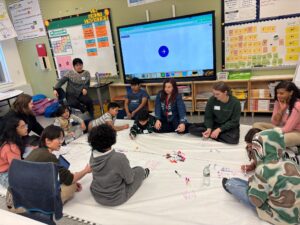
The Cooney Center and The GIANT Room facilitate co-design sessions with elementary students and a product team in NYC.

We have learned that most product teams are really eager to do this work. The barrier is usually not willingness, but access, staffing, and capacity. We bring together learning scientists, literacy experts, and kids; and provide the time and structure needed to translate research into design.

We have also found that product teams are surprised by how much they learn, especially from our literacy experts. Many teams have former educators or others with knowledge of the science of reading on staff. Still, they may not be familiar with the latest research, how to support different populations of learners, or how to address the various strands of Scarborough’s Reading Rope beyond phonics.

We have also found that many in the industry who use the terms “child-centered design” or “co-design” still tend to rely mostly on adult intuition or playtesting existing prototypes rather than ideating with kids from the start. As a result, we’ve learned that while publishing research and guidance for the field is necessary, it’s not sufficient to create the kind of change needed in ed tech products. Working alongside a team over a six-month engagement creates more time for iterative conversations and design cycles to achieve these goals.

Where do you see your work in five years?

Through our Sandbox initiative and Well-Being by Design fellowship, we’re deepening our work with designers, developers, and curriculum leads on product teams, and we hope to build momentum among these individual professionals. In five years, we would like to see leaders at technology companies and across the field recognize how critical this work is and invest the time, resources, and support needed to design for children’s learning and well-being.

This requires taking a developmental approach to everything they design for kids and using screens and technology thoughtfully to achieve specific goals, whether the goal is learning, well-being, or fun. We want to see higher standards across the industry; more transparency for educators, parents, and kids; and kids empowered to be active participants in designing technology meant for them.

What else should people know?

I love the role that the Cooney Center plays as a connector in the field. Though we’re a small team, we maintain ties with academia, industry, educators, policymakers, philanthropy, and other sectors. We aim to bring people together and cross-pollinate ideas so that those working across children’s media, AI, educational technology, games, and related fields can learn from one another and break down silos. To follow our work, please subscribe to our newsletter.

Tasha Hensley

Policy Director

Twitter Linkedin
Previous Post

1 thought on “5 Questions With Medha Tare, Ph.D.”

  1. Garry DeArmond
    09/09/2026 at 7:37 PM

    Excellent article, Medha. One point really stood out to me: too often, “child-centered design” begins with adult intuition, and children are only brought in after the product has already been built.

    I would add another test of thoughtful technology: what happens after the screen is turned off? If the experience stays alive in a child’s imagination and carries into willing action in the real world, it has done more than capture attention. It has helped create agency.

    That bridge between research, imagination, and behavior is where I believe some of the most meaningful work for children can happen.

    Reply

Leave a Reply Cancel reply

Your email address will not be published. Required fields are marked *

Contact Us

General Inquiries

info@the-learning-agency.com

Media Inquiries

press@the-learning-agency.com

X-twitter Linkedin

Mailing address

The Learning Agency

700 12th St N.W

Suite 700 PMB 93369

Washington, DC 20002

Stay up-to-date by signing up for our weekly newsletter

© Copyright 2026. The Learning Agency. All Rights Reserved | Privacy Policy

Stay up-to-date by signing up for our weekly newsletter